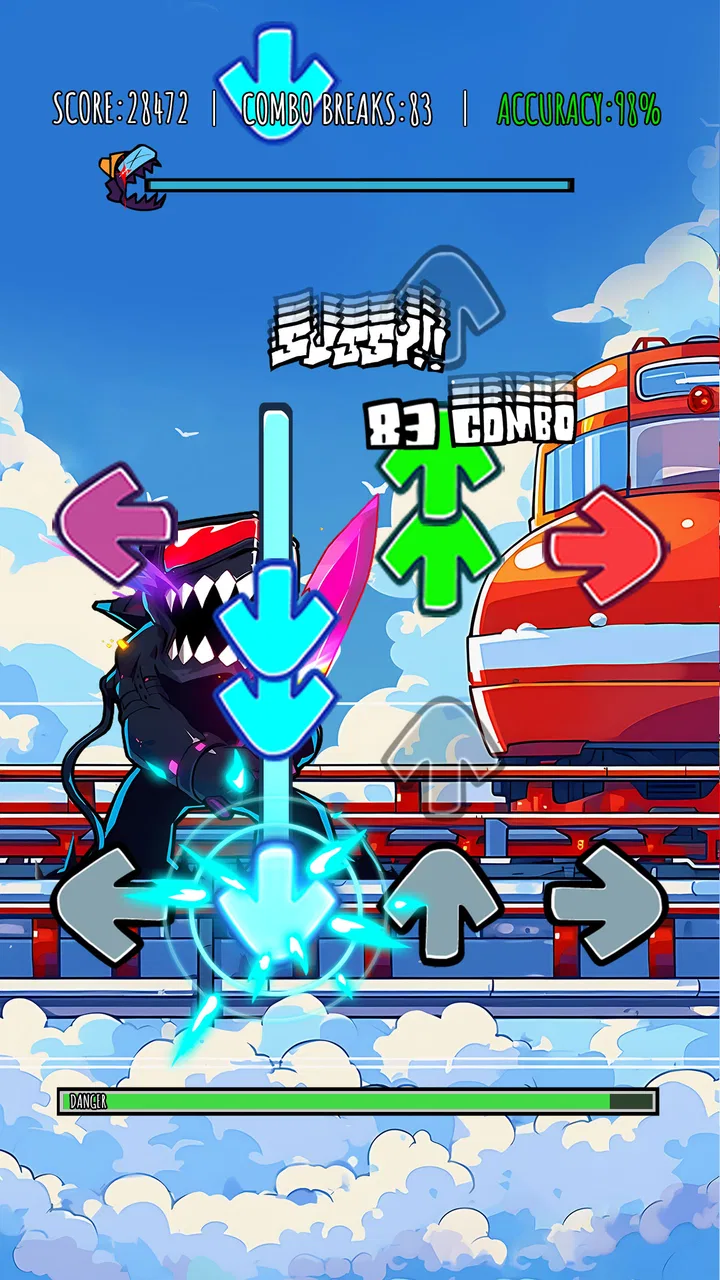
Music Rhythm Battle Night
- 4.4
- Rating
- 1.00M
- Installs
- Free
- Price

 Analysis by App-foxy
Music Rhythm Battle Night is a free music game from HOLA GAME that asks for a simple kind of concentration: listen, watch, and move your thumbs in time with the beat. I found the appeal easy to understand within a few minutes. It is not trying to replace a full music player or become a complicated strategy title; it is built around the satisfaction of matching input to rhythm while a song keeps pushing forward.
That focused idea gives it a clear identity, but it also creates a very specific audience. If you enjoy rhythm challenges and like improving through repeated attempts, this is the sort of game that can fit neatly into short breaks. If you want a relaxed game where mistakes barely matter, or a music experience based on discovering and controlling your own songs, you may find the format restrictive. My overall impression is that the game works best when treated as a quick skill exercise rather than a broad, all-purpose mobile game.
How the first sessions establish a reason to keep playing
The early goal is refreshingly direct: stay with the music and respond at the right moment. That clarity matters on a phone, where a game has only a short window to explain why it deserves space on your screen. Instead of making me learn a large set of rules before playing, the rhythm itself becomes the tutorial. I could immediately tell whether my timing was improving because successful inputs felt connected to the track rather than to a complicated menu system.
You May Also Like

 Blood Strike: 2.5 Anniversary
Blood Strike’s Loadouts Turn Every Drop Into a Tactical Gamble
A close look at Blood Strike’s custom loadouts: how fast access to signature weapons reshapes its battle royale rhythm, rewards preparation, and narrows the gap between fights.

 Pandora - Music & Podcasts
Pandora’s Music Is Easy to Start, but Harder to Recover
Pandora’s strength is its low-effort path from a seed to a station. Its weak spot is how much confidence it asks you to place in connection, setup, and quiet recovery.

 8 Ball Pool
 Is Built on Rivalries, Rematches, and Routine
A close look at the rivalries, rematches, shared routines, and unanswered safety questions that turn a quick pool match into a persistent mobile community.

 Samsung Music
’s Quiet Strength Is Playing What You Already Own
Its reach comes less from spectacle than from dependable access to a personal library. That simplicity is both the app’s strongest retention engine and its ceiling.

 AccuWeather: Weather Radar
AccuWeather Review: A Quick, Clear Forecast for Everyday Decisions
For everyday plans, the best forecast is the one you can understand quickly. AccuWeather makes rain timing, radar, and local conditions easy to act on, with a few trade-offs.

 Hill Climb Racing
Why Hill Climb Racing Still Turns Crashes Into One More Run
A tiny car, a bumpy hill and one more upgrade: Hill Climb Racing keeps resurfacing because its simple chaos makes every near-miss feel personal.
More From Our News Desk



For a new player, the first useful target is not a distant reward. It is getting through a section with fewer missed beats than before. That creates a practical loop: play, notice where concentration slipped, and try again with a slightly different approach. I recommend beginning with a light touch instead of tapping aggressively. On a small screen, hurried movements can make you lose the beat even when you have heard the pattern correctly.
The thumb-focused design also makes the game approachable for people who do not normally play action games. You do not need a controller, a large display, or a long uninterrupted session. A spare moment while waiting for an appointment can be enough for an attempt. At the same time, the simplicity should not be confused with a lack of demand. Once the music becomes familiar, the challenge shifts from understanding the controls to maintaining attention when the sequence becomes less forgiving.
I found the best early routine was to play one attempt without worrying about the result, then replay while focusing on one problem area. That might mean watching the incoming cues more carefully, listening for the beat instead of relying only on sight, or keeping both thumbs relaxed. This is a small but important distinction from casual tapping: improvement comes from identifying a specific mistake, not from repeating the same rushed movement.
The game’s free entry point is another reason it is easy to test. Music Rhythm Battle Night can be installed without an upfront purchase, while optional in-app items are priced from $1.99 to $2.99 each. That makes trying the core experience relatively low-risk, but I would still advise deciding what you actually want from the game before buying anything. A purchase may feel worthwhile to a committed rhythm player, yet it will not automatically solve timing problems or make the underlying challenge disappear.
What counts as progress during ordinary play
Progress in a rhythm game is often more personal than it first appears. The most meaningful signal is not simply reaching a later point; it is gaining control over a passage that previously caused repeated misses. In my experience, the game encourages that kind of self-measured progress because every attempt gives immediate feedback through the relationship between the beat and the thumb movement.
That feedback is useful when I treat the screen and sound as two parts of the same instruction. Watching alone can lead to late reactions, especially when visual movement becomes busy. Listening alone can also be unreliable if I lose track of where the next input is positioned. The stronger method is to use the visual cue to prepare and the music to confirm timing. This approach is one of the more valuable habits the game can teach, and it carries over to other rhythm titles.
Another practical signal is consistency. A lucky sequence of accurate taps is satisfying, but repeating similar performance across several attempts tells me more about whether I have actually learned the pattern. I would not judge the game only by a single successful run. For me, the real improvement appeared when I could stay composed after one mistake instead of letting that error disrupt the next several inputs.
This is also where the game may feel less rewarding to players who expect a visible, story-driven progression system. Its strongest sense of advancement comes from performance and familiarity with the rhythm. If you need a large narrative, a character-building structure, or a long list of clearly explained unlocks to stay interested, the experience may seem thin. I prefer that the central skill remains visible, but I understand why some players will want more layers around it.
One useful habit is to stop after a short run of unfocused attempts. Rhythm games can make players believe that persistence alone is always productive, but tired hands and scattered attention often reinforce bad timing. A brief pause, lower volume, or change in grip can help more than immediately starting again. This is especially relevant on a phone, where cramped posture can become part of the difficulty without the player noticing.
Where the challenge begins to separate beginners from practiced players
The difficulty curve feels most interesting when the basic action is already familiar. At that point, the challenge is no longer “Can I tap?” but “Can I predict, listen, and recover without losing the flow?” That distinction gives the game more staying power than its short store summary might suggest. The input may be easy to understand, yet accurate timing demands patience.
New players should expect a learning curve based on rhythm recognition rather than complex controls. I found that looking too far ahead can be just as harmful as staring at the current cue. The better balance is to keep attention slightly ahead while allowing the beat to guide the final movement. This reduces panic during denser moments and makes the sequence feel like a phrase instead of a string of unrelated commands.
Players who are already comfortable with music games will probably notice the limitations sooner. A specialist rhythm title with a deeper charting system, more extensive customization, or a larger competitive structure may offer more long-term variety. Music Rhythm Battle Night is easier to pick up, but that accessibility can also mean that experienced players reach the edge of its appeal more quickly.
There is a worthwhile trade-off here. A demanding rhythm game can be impressive but intimidating, while this game’s direct thumb interaction makes it suitable for casual sessions. I would recommend it to someone who wants a gentle entry into the genre, especially if they enjoy repeating a song to improve. I would be more cautious about recommending it to a player who already spends most of their time on advanced rhythm games and expects a deep technical ceiling.
Device setup can influence the experience more than people expect. I get better results when I hold the phone securely without squeezing it and keep my thumbs close to their natural resting positions. Playing while walking, riding in a moving vehicle, or using one hand makes timing less dependable. Those situations may be fine for testing the game, but they are poor conditions for judging whether a difficult section is genuinely beyond your skill.
The Teen content rating is worth keeping in mind for families choosing games for younger players. It does not change the basic nature of the experience, which remains centered on music and timing, but parents should still check the device’s purchase controls before allowing optional spending. Because individual items cost between $1.99 and $2.99, a simple purchase restriction can prevent an accidental charge during a quick session.
What sustains attention, and where retention can feel forced
The strongest reason to return is the familiar rhythm-game desire to improve one more time. A near-success can be enough motivation when I know the mistake came from a specific lapse rather than bad luck. The game benefits from that compact loop because it does not require a large time commitment. I can play for a few minutes, put it down, and return later without needing to remember a complicated story or inventory.
That same structure can become repetitive if the available challenge does not feel meaningfully different from one attempt to the next. Rhythm games rely heavily on the quality and variety of their musical sequences. When the music and patterns keep me alert, repetition feels like practice. When they stop surprising me, replaying can feel more like grinding. This is the main retention trade-off I would consider before spending money inside the game.
I also think the game is better for goal-oriented players than for people who need constant novelty. My personal short-term goals would be to complete a run with fewer interruptions, improve consistency rather than chase one lucky score, and identify the exact moment where concentration breaks. Those goals turn a small session into something measurable without pretending that every play needs to become a major achievement.
A realistic everyday use case is a short evening break after work or school. I can play a few attempts with headphones, focus on one troublesome rhythm, and stop before fatigue turns the session into frustration. It is less suitable when I want to unwind passively, because the game asks me to pay attention. It also may not be ideal in a noisy public place, where outside sound makes it harder to use the music as a timing reference.
Compared with a conventional casual puzzle game, this title offers more active involvement and a clearer connection between practice and improvement. Compared with a music-streaming app, it is interactive rather than relaxing background entertainment. Compared with a large rhythm-game alternative, it feels more immediately approachable but potentially less satisfying for players seeking extensive systems. Those comparisons help define its place: it is a compact music challenge, not a replacement for every other type of music app.
Version, access, and the kind of player I would recommend
The current version is 1.2.7, and the game supports Android 7.0 and later. That gives it a reasonably broad starting point for Android users with older compatible devices. I would still judge the experience on the phone you plan to use most, because screen size, touch responsiveness, speaker quality, and headphone comfort all affect a timing-based game more than they affect a typical turn-based title.
Its audience is already substantial, with over one million installs, while the average rating sits at 4.4 from around ten thousand ratings. Those figures suggest that the central idea connects with many players, but they should not replace personal testing. A player who loves beat-based repetition may find the game immediately enjoyable, while someone who dislikes replaying short sequences may not understand the appeal even after a few attempts.
I would recommend it to casual rhythm-game newcomers, players who enjoy improving through repetition, and anyone looking for a quick thumb-based challenge that can fit between longer activities. It is also a reasonable choice for someone who wants to test whether music games are enjoyable before moving to a more demanding alternative. The free download makes that decision easier, provided optional purchases are treated as extras rather than necessities.
I would suggest skipping it if your priority is composing music, importing a personal library, exploring a long narrative, or relaxing without constant input. I would also look elsewhere if you need a highly competitive environment or a deep progression framework with many clearly differentiated systems. The game’s focused design is its advantage for some players and its limitation for others.
My progression verdict after weighing the whole loop
Music Rhythm Battle Night succeeds when its goals stay close to the music. The early objective is understandable, progress is easiest to feel through better timing, and the challenge can encourage repeated attempts without demanding long sessions. I like that the game can turn a few spare minutes into a small practice routine, and I appreciate that the controls do not create a barrier before the rhythm itself becomes the test.
Its weaker side is the risk of repetition. The experience depends on whether the available musical challenges continue to make you want to improve rather than merely continue. Players who need frequent unlocks, extensive customization, or a broader set of activities may feel that the loop runs out of energy. That is not a flaw I would hide; it is the central trade-off behind the game’s straightforward design.
For me, the sensible approach is to play it free first, use headphones when timing matters, keep sessions short enough to stay focused, and judge purchases by whether I am still enjoying the practice loop after several returns. The best reason to keep Music Rhythm Battle Night installed is the feeling of turning a missed beat into a reliable one. As a free music game from HOLA GAME, it earns a recommendation for focused, casual rhythm play, while more demanding or feature-heavy players should treat it as an accessible starting point rather than a complete genre destination.
FAQs for Music Rhythm Battle Night
01What is Music Rhythm Battle Night about?
Music Rhythm Battle Night is a dynamic rhythm-based game that challenges players to hit the right notes in time with the music. It features various music tracks and difficulty levels, allowing players to test their timing and reflexes while enjoying an engaging musical experience.
02Is Music Rhythm Battle Night free to play?
Yes, Music Rhythm Battle Night is free to download and play. However, it offers in-app purchases and optional subscription plans that provide additional songs, customization options, and ad-free gameplay. These purchases enhance the gaming experience but are not required to enjoy the core features.
03What devices are compatible with Music Rhythm Battle Night?
Music Rhythm Battle Night is available on both Android and iOS platforms. It supports a wide range of devices, but for the best performance, it is recommended to use newer models with updated operating systems. Check the app store for specific compatibility requirements for your device.
04Does Music Rhythm Battle Night require an internet connection?
Music Rhythm Battle Night can be played offline, allowing you to enjoy the rhythm challenges without an internet connection. However, some features, such as downloading new songs and participating in leaderboard competitions, require an active internet connection.
05How can I improve my skills in Music Rhythm Battle Night?
Improving your skills in Music Rhythm Battle Night involves practice and familiarity with the game’s mechanics. Start with easier tracks to build your timing and accuracy, then gradually move to more challenging levels. Utilizing practice mode can also help you perfect difficult sections of the songs.
Pros
- Engaging rhythm-based gameplay.
- Variety of music tracks available.
- Intuitive and responsive controls.
- Regular updates with new content.
- Offline mode for on-the-go play.
Cons
- In-app purchases can get pricey.
- Occasional lag on older devices.
- Limited character customization.
- Repetitive levels over time.
- Ads can interrupt gameplay.

Music Rhythm Battle Night
Gallery